

Chicken Plinko Game Review: Two RTPs and an Unexplained 1,000x
In short — our verdict: 5.8/10 — Onlyplay's Chicken Plinko is a tidy instant game we can only recommend as a free demo. Its maker prints two different return figures and names no licence that a reader can check.
You drop one egg per bet onto eight rows of pegs, and it lands in one of eleven baskets worth x0.2 to x20. We played 83 of those drops in the studio's free demo and read every line of the rules inside the client.
5.8/ 10
- Return figure5.5
- Licence and certification3.0
- Features7.5
- Stakes and ceiling6.0
- Disclosure7.0
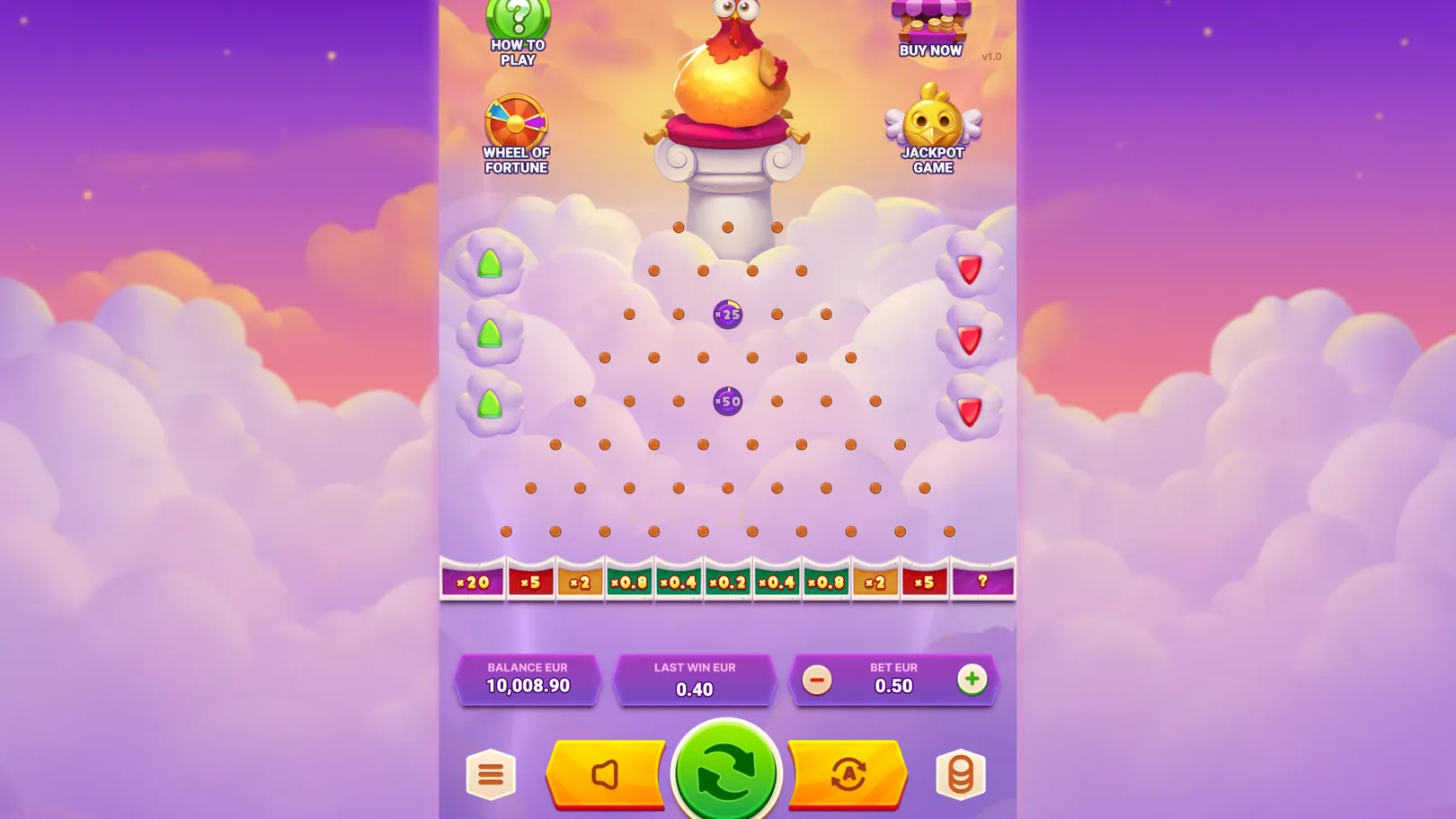
Table of contents
- Chicken Plinko Strengths and Weaknesses
- 83 Drops in the Plinko Demo
- Eleven Baskets, Five Below the Bet
- Plinko Basket Payouts per Drop
- How This Plinko Differs from the Rest
- Two Return Figures from One Studio
- The 1,000x Ceiling Has No Feature
- Bonus Features We Never Triggered
- Infinite Autoplay and a Bonus Shop
- The Studio Behind the Chicken
- Before a Real-Money Session
- What Each Studio Surface Prints
- Our Chicken Plinko Verdict and Rating
- Key Terms Used on This Page
- What Else Do Readers Ask
Chicken Plinko Strengths and Weaknesses
Pros: What Works Well
- Pro: The free demo opens on the studio's own launcher with a €10,000.00 play balance, no sign-up needed.
- Pro: The rules document inside the client prints a return figure, 96.00%, instead of leaving it to the marketing page.
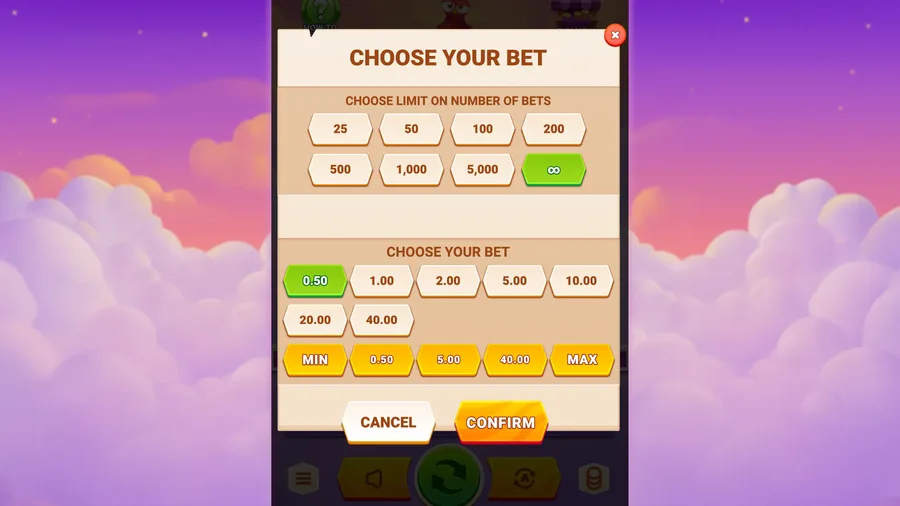
- Pro: Seven stakes from 0.50 to 40.00 keep a test cheap: our 83 drops cost 41.50 in play credits.
- Pro: Six extras, from bumpers to thirty Free Eggs, fit on one compact board.
- Pro: Nine help screens explain every feature in plain words before the first drop.
Cons: What Holds It Back
- Con: Two return figures from the same studio: 96.00% in the client rules, 96.14% on the game page.
- Con: The 1,000x ceiling comes with no feature attached; the rules name no ceiling at all.
- Con: Half of the ten fixed baskets pay back less than the stake.
- Con: Autoplay opens on the infinity setting, so a session has no stop unless you set one.
- Con: The studio names no legal entity, regulator or licence number, and two public licence registers hold no Onlyplay entry.
83 Drops in the Plinko Demo
| Measure | Result |
|---|---|
| Date played | |
| Drops at the default stake | 83 |
| Stake per drop | 0.50 |
| Opening balance | 10,000.00 |
| Closing balance | 10,007.20 |
| Total staked | 41.50 |
| Total returned | 48.70 |
| Best single payout | 10.00, twice |
| Bonus features triggered | 0 |
Read on ; a source can change without notice.
Eleven Baskets, Five Below the Bet
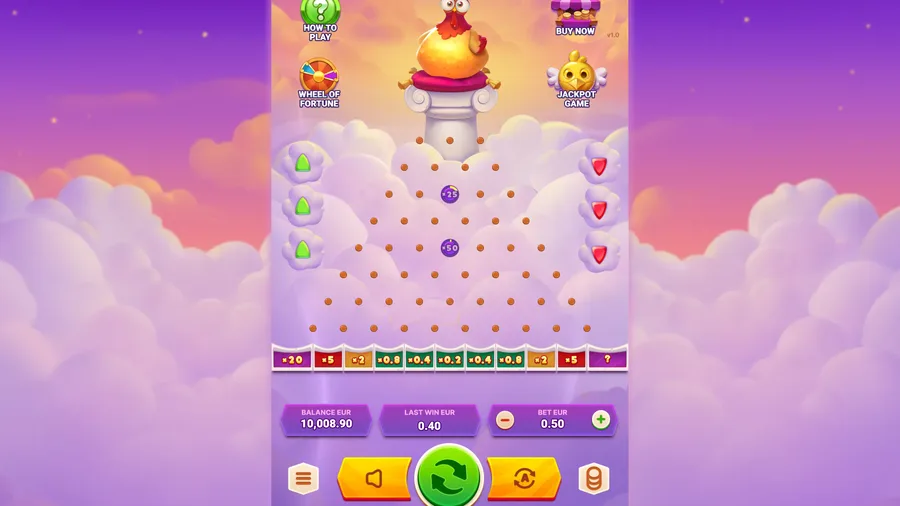
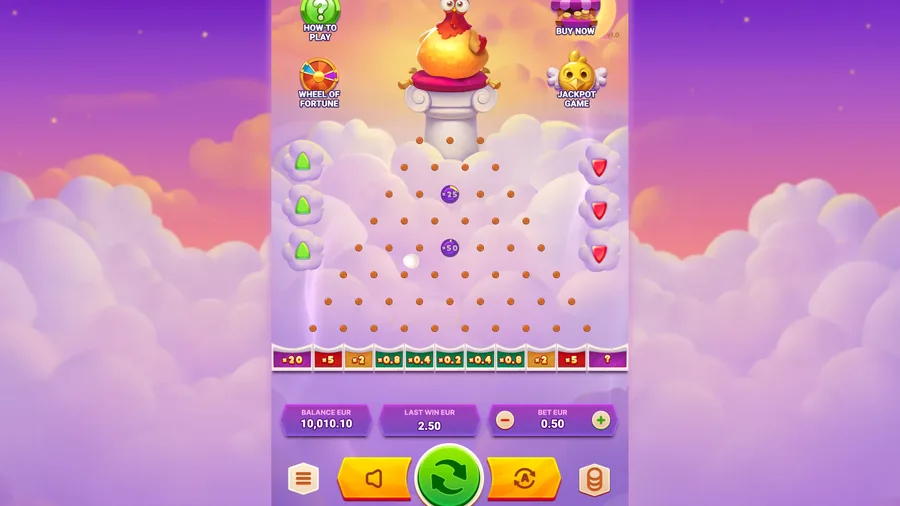
One bet buys one egg, and a single row of eleven baskets decides what it pays. Ten baskets carry fixed multiples in a mirror pattern: 20, 5, 2, 0.8, 0.4, 0.2, then back up to 5. The eleventh, at the right-hand end, is a mystery basket.
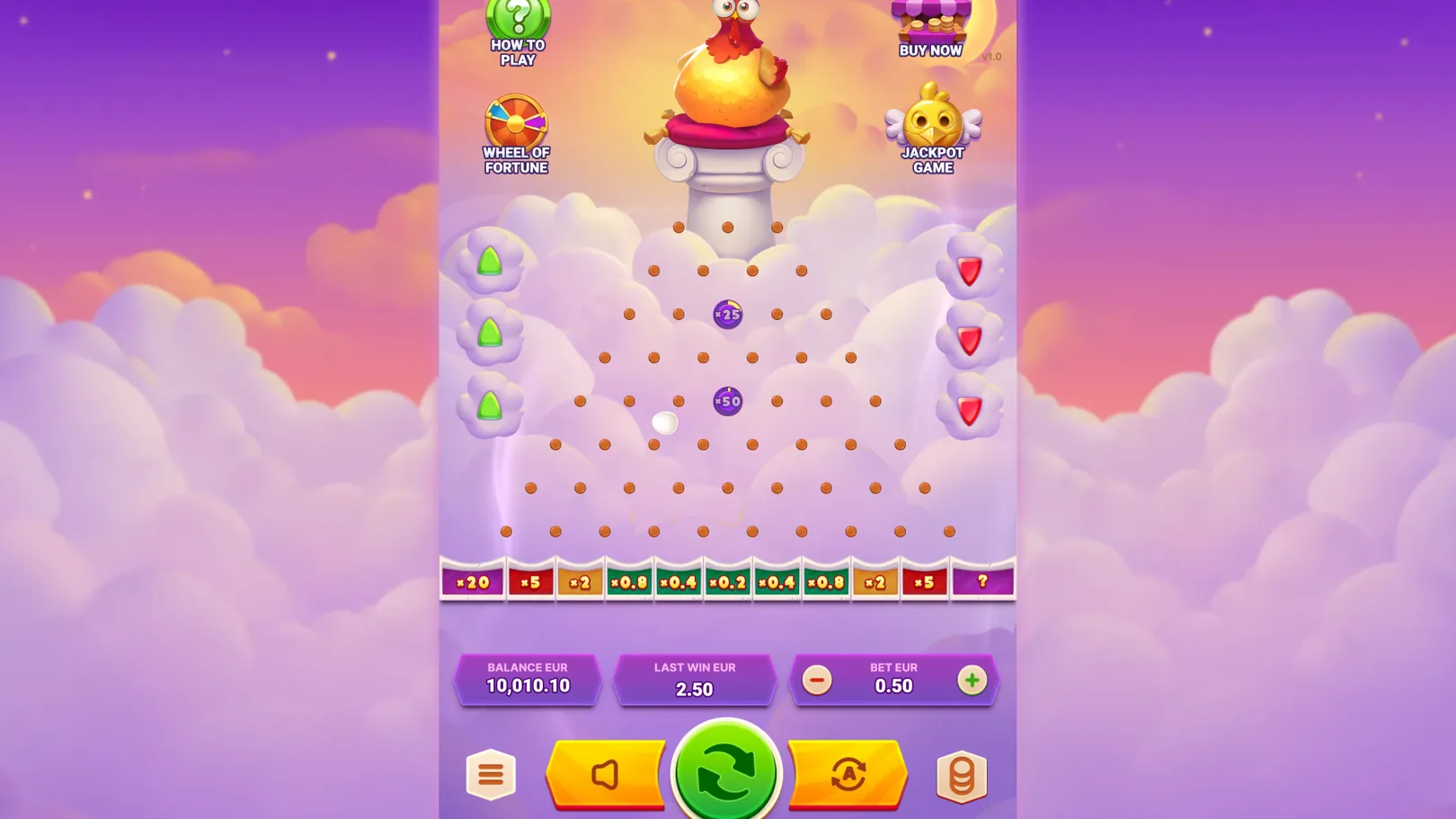
An egg can also break in the air or miss every basket. Then the bet is simply gone.
The coloured funnels are the board's bit of theatre. Green ones on the left blow eggs upward, red ones on the right push them down. Yet the rules say these winds "do not impact the final payout", so they're scenery in a physics costume.
Plinko Basket Payouts per Drop
| Multiplier | Baskets on the board | Pays at the default stake |
|---|---|---|
| x20 | 1 | 10.00 |
| x5 | 2 | 2.50 |
| x2 | 2 | 1.00 |
| x0.8 | 2 | 0.40 |
| x0.4 | 2 | 0.20 |
| x0.2 | 1 | 0.10 |
| Mystery, random x2, x5 or x20 | 1 | 1.00, 2.50 or 10.00 |
Three of the six fixed values, x0.8, x0.4 and x0.2, hand back less than the stake, and they fill five of the ten fixed baskets. In our 83 drops, every win apart from two 10.00 hits and at least three 2.50s was 0.10, 0.20, 0.40 or 1.00.
How This Plinko Differs from the Rest
This plinko differs from the rest by removing two dials: Plinko titles from BGaming, Spribe and the Stake originals drop a ball and let the player choose a risk setting and a row count. The board here always has eight rows, an egg replaces the ball, and nothing needs tuning before a drop.
Those boards run to as many as sixteen rows, and all three are sold as provably fair. This game is a plain RNG title with no seed, hash or client value to check.
We'd argue the fixed board suits a casual player better. There's no setting to blame when a session goes cold. Anyone who wants control over variance will find the board rigid, though, which is a fair reason to prefer the ball versions.
The name causes its own mix-ups. Chicken Road is an InOut Games crash game with a different mechanic. One affiliate site even credits InOut with this title by mistake; in fact Onlyplay made it, and its catalogue of 178 entries across 30 pages holds only this one plinko.
Two Return Figures from One Studio
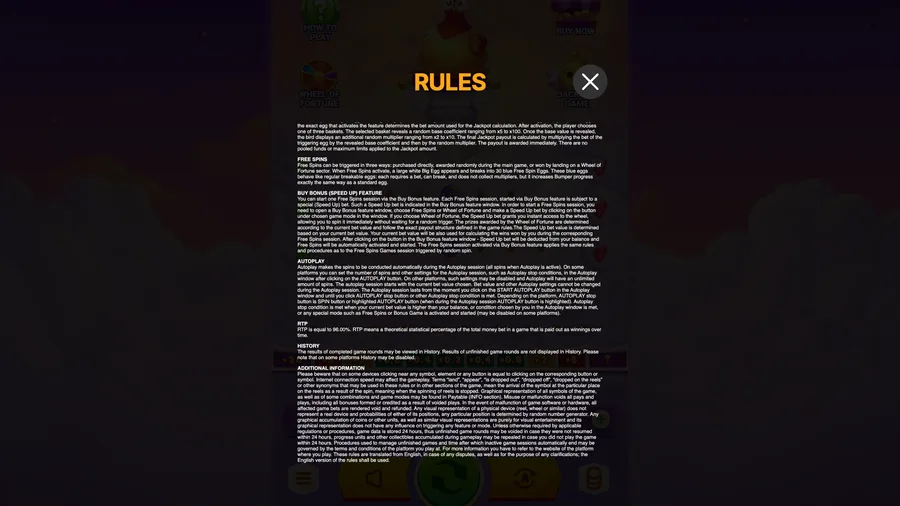
Onlyplay publishes two return-to-player figures for this game, both its own. The rules document inside the client says "RTP is equal to 96.00%", while the studio's game page prints a 96.14% return to player beside "Volatility Medium".
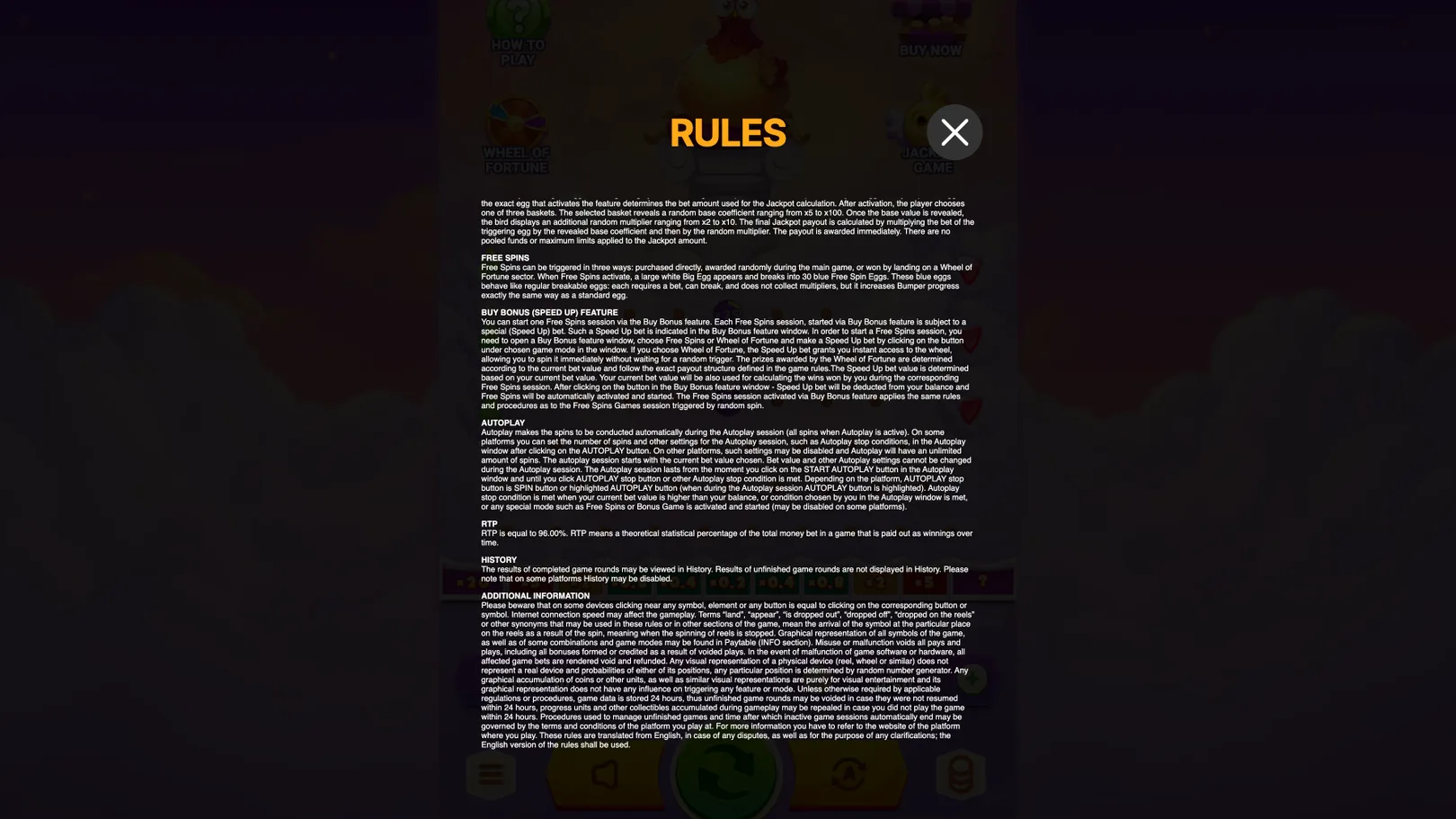
That 0.14-point gap is small in money. On the rules figure the house keeps 4.00% of stakes over time, on the page figure 3.86%. A player has no way to read from the screen which build a given operator runs.
Finding either number takes effort. The main game screen stays blank on this point because the server leaves its displayRtp setting empty. The only place a player meets a figure is the RULES document behind the menu.
The studio's terms settle any conflict in favour of "the applicable certified documentation or operator configuration". We searched for a laboratory certificate covering this title or the studio, and found none published where we looked. That tie-breaker points at a document a reader can't open.
Two more numbers float around. A 77.27% hit rate appears only in the launch press release of . Catalogues also argue with the studio about volatility, one listing it as high and another as medium-high, while the scale itself goes unexplained.
The 1,000x Ceiling Has No Feature
Onlyplay's game page says "Max win 1,000×" and stops there. It names no feature, and the rules document names no ceiling at all.
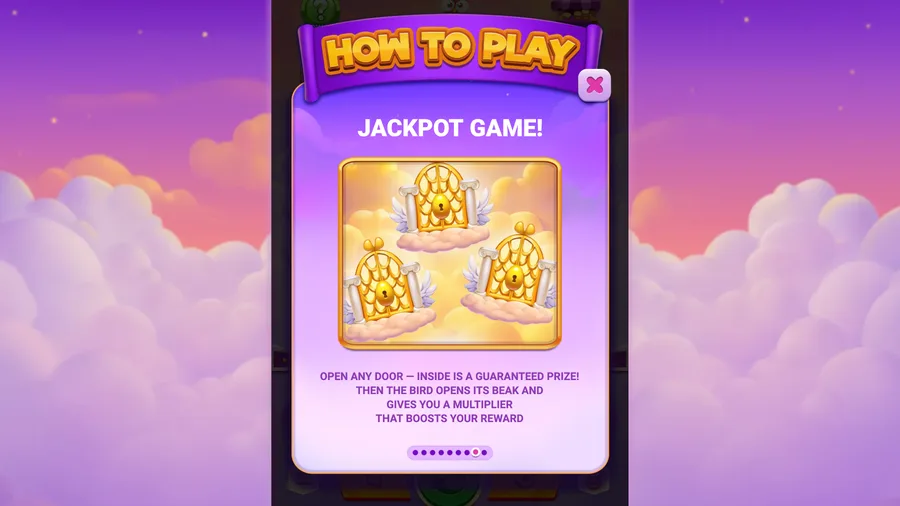
The rules do contain one route that lands exactly on that number. The Jackpot Game reveals a base coefficient of x5 to x100 behind a door. The bird's beak then adds x2 to x10, and the two multiply: 100 × 10 is 1,000 times the bet of the triggering egg.
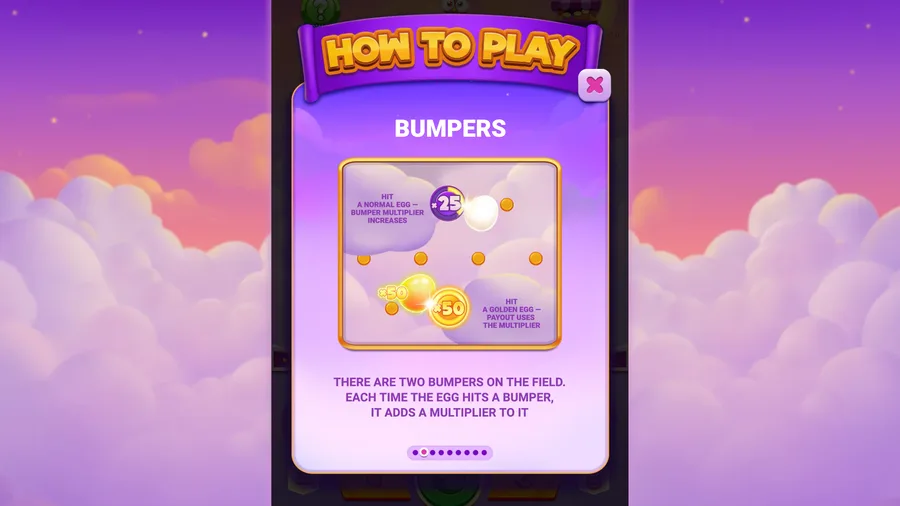
Bumpers spoil the neat picture. The server caps each of the two bumpers at 500. A golden egg pays bumpers and basket separately, as the rules' own example shows: "x50 + x50 + x2 = x102". Push both bumpers to their cap, add the x20 basket, and the rules' arithmetic reaches x1,020 on one golden egg.
Nobody explains how the 1,000x figure applies to that sum. In money, 1,000x is 500.00 at the demo's 0.50 default, or 40,000.00 at its top stake of 40.00. Bigger figures in some catalogues belong to other games, to table errors or to numbers nobody explains; Onlyplay itself never prints them.
Bonus Features We Never Triggered
Six extras sit on the board, and in 83 drops none of them paid out: two bumpers, the golden egg, a bomb, the wheel, the Jackpot Game and thirty Free Eggs. Golden eggs cash the bumpers. A bomb collects both bumpers without touching them, while a battery starts the wheel.
Lightning raises the odds of the Jackpot Game. A giant egg, finally, breaks into thirty Free Eggs.
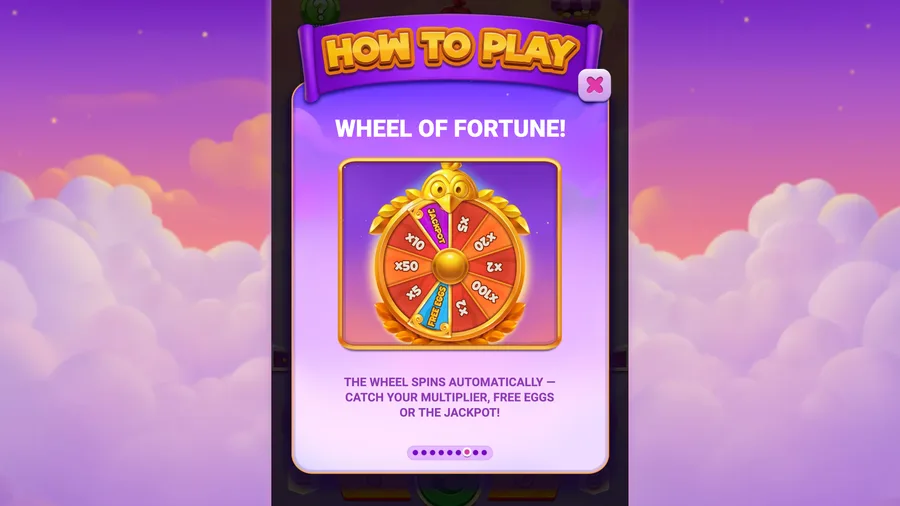
The wheel's ten sectors read x2, x2, x5, x5, x10, x20, x50 and x100, plus one Free Eggs sector and one Jackpot sector. The Jackpot Game is no progressive either, since the rules rule out "pooled funds" for it.
What the studio leaves out is frequency. Neither the help screens nor the rules say how often a feature arrives, so our dry run proves little either way. Honestly, we can't promise you'll see one in a short session.
Infinite Autoplay and a Bonus Shop
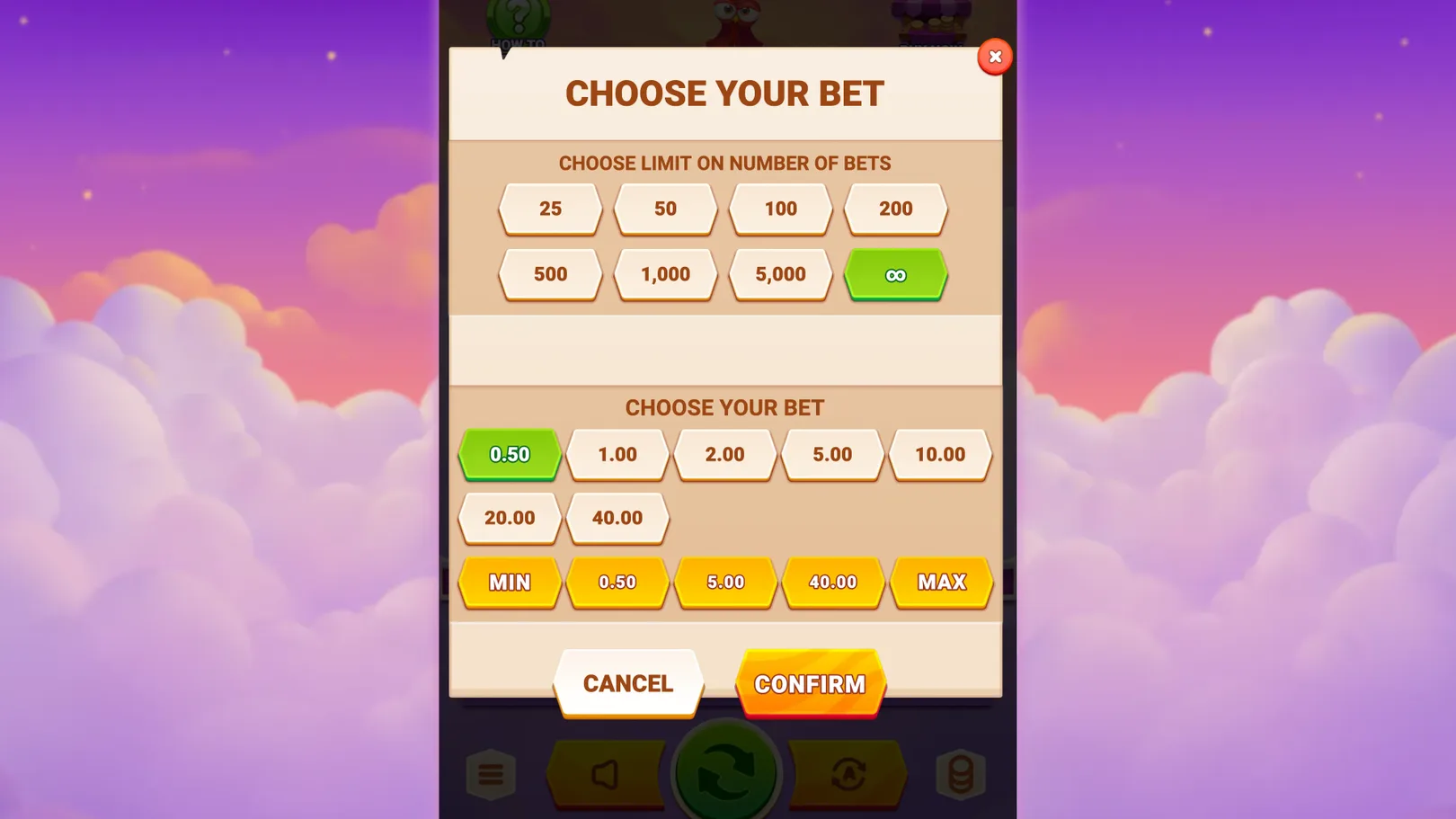
The demo runs autoplay with no limit by default and sells three bonus features in a shop. The bet-count limit in the stake window opens on the infinity sign, so drops keep coming until the player picks a number. The rules add that some platforms disable autoplay settings altogether, leaving the round count unlimited.
The shop sells features outright. Thirty Free Eggs cost 30 times the bet, the wheel 50 times, the Jackpot Game 200 times. At the 0.50 default the BUY NOW window prices them at 15.00, 25.00 and 100.00.
We do not recommend the 200x Jackpot Game purchase. The smallest jackpot the rules allow is x5 behind the door times x2 from the beak, or 10 times the bet. The studio publishes that range but keeps the odds inside it to itself, so the price buys an unknown.
The Studio Behind the Chicken
Onlyplay released the game on , and the client we played reports itself as v1.0. The studio's footer reads "© 2026 Onlyplay" beside three email addresses. Its site gives no legal entity, address or licence number.
Two public licence registers, both downloaded in full on , hold no Onlyplay entry. Searching the same files finds Pragmatic Play, Evolution and Playtech, so the empty result is a real absence.
Trade profiles name a licence for Onlyplay but give no licence number, and nothing on the studio's own site confirms it. The studio's own pages stay silent on it too.
Before a Real-Money Session
The legal side depends on where the reader lives, so this page names no casino and no country. What can be checked anywhere is the site itself. Its licence number should open in the regulator's own public register. The RULES document should show 96.00%, and the stake list should match the seven we used, from 0.50 to 40.00.
The rules keep an unfinished round for a day, after which the platform may void it. Set a loss limit before the first drop, since autoplay opens on infinity.
Free help exists in two forms. Gambling Therapy, a Gordon Moody service, offers free online support to anyone, anywhere. Gamblers Anonymous runs meeting groups with a search for the nearest one. For anyone who simply wants to see the game, the free demo remains the one version of this game that asks for no stake.
What Each Studio Surface Prints
| Surface | Return figure | Ceiling | Volatility |
|---|---|---|---|
| Rules document in the client | 96.00% | not named | not named |
| Studio game page | 96.14% | 1,000x | Medium |
| Main game screen | nothing shown | nothing shown | nothing shown |
Our Chicken Plinko Verdict and Rating
Key Terms Used on This Page
- Mystery basket
- The eleventh basket, marked with a question mark, which pays a random 2, 5 or 20 times the bet.
- Bumper
- One of two board targets, marked x25 and x50, that gain +0.1 each time an ordinary or free egg hits them and pay out when a golden egg touches them.
- Golden Egg
- An egg that costs a normal bet, never breaks and collects any activated bumper it touches, paid separately from its basket.
- House edge
- The share a game keeps in theory: 4.00% on the rules figure of 96.00%, or 3.86% on the game page figure.
- Speed Up bet
- The rules' name for buying Free Eggs at 30x or the wheel at 50x the bet; the shop also sells the Jackpot Game at 200x.
Not sure yet? Try the free demo first: it runs on play money, with no account and no stake.
Try the free demo first →This site takes no deposits and runs no identity checks; both stay off it entirely.
Related Reading on This Game
More on this game, from the same section first:
 Guides
Free demo, no sign-up
10,000.00 EUR play balance, stakes 0.50-40.00
 Reference
Two RTP figures
96.00% in rules, 96.14% on page
 Guides
Bonus games explained
Wheel x2-x100, jackpot door x5-x100
 Guides
Rules, step by step
8 rows, 11 baskets, x0.2 to x20
 Guides
Site checklist
7 checks; RULES should show 96.00%
 Reference
1,000x ceiling explained
1,000x ceiling, no route named
 Reference
Studio and licence check
0 entries in two licence registers
 Reference
Against classic Plinko
8 fixed rows, RNG, no seed
What Else Do Readers Ask?
Readers mostly ask what the demo needs, where the numbers live inside the client and how the odd baskets pay. Every answer below comes from the rules document, the help screens or our 83-drop log.
Is an account needed to try it?
No, the studio's public launcher opens the demo without registration, starting at €10,000.00 of play money with the same seven stakes we used.
Where does the client show the return figure?
The return figure appears only in the RULES document reached through the menu, which states 96.00%; the main game screen shows no figure at all.
Does the mystery basket pay more than x20?
No, the question-mark basket picks x2, x5 or x20 at random, so its best case only matches the fixed x20 basket on the opposite end.
Can a golden egg break?
No, the rules say a golden egg never breaks; it still costs a normal bet, and it pays any activated bumper it touches plus the basket it lands in.
How long does the game keep an unfinished round?
Game data is stored for 24 hours under the rules, so an unfinished round left longer than that may be voided by the platform.
How did we test the game?
We opened the studio's launcher, read all nine help screens and the full rules, decoded the server's stake and bonus settings, and logged 83 drops at 0.50.
Is this the same game as Chicken Road?
No, Chicken Road is a crash game from InOut Games; Onlyplay made Chicken Plinko, though one affiliate site wrongly lists InOut as its maker.